
Trusted by leaders and organizations since 1980.
Effectiveness Institute helps organizations increase engagement by improving how individuals and teams work together.
Since 1980, we have partnered with organizations across industries to strengthen communication, collaboration, and leadership—helping create workplaces where people feel connected to their work, respected by their colleagues, and proud of what they accomplish together.
Our experience and research show that engagement and performance improve when organizations focus not only on what work gets done, but also on how people work together to achieve it.
Our Beginning
Effectiveness Institute was founded in 1980 by Dr. Bill Maynard and Tom Champoux.
Bill and Tom’s partnership began years earlier at Cleveland High School in Seattle. At the time, Cleveland faced the district’s highest rates of absenteeism, suspensions, dropouts, and violence. Bill and Tom focused on transforming the school’s culture through collaboration, accountability, life-skills education, and values-based leadership.
The results were extraordinary. Within a few years, Cleveland moved from the district’s worst performance indicators to its best, becoming a national example of successful organizational change.
In 1980, Bill and Tom brought these same principles into businesses and universities. Since then, Effectiveness Institute has helped tens of thousands of leaders and teams create measurable, lasting improvements in performance and effectiveness.
In 2019, Senior Partner George Myers became President and CEO of the Institute, continuing to evolve and expand the work while building on the legacy Bill and Tom established.
Our Philosophy
Understanding the factors that drive performance in organizations.
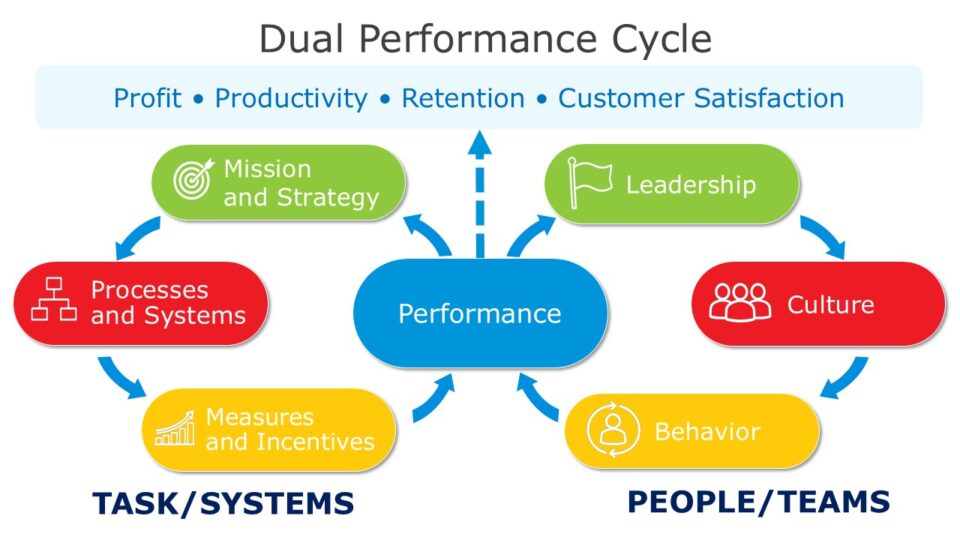
To better understand the factors that influence organizational performance, we developed the Dual Performance Cycle.
The model highlights how results are influenced by both Task/Systems factors—such as strategy, structure, and incentives—and People/Teams factors, including leadership, culture, communication, and
behavior.
While organizations often focus heavily on systems, experience and research show that the effectiveness of leaders and teams plays an equally important role in determining results.
High performance occurs when both sides of the Dual Performance Cycle are strong: systems that support effective execution and leaders and teams who communicate, collaborate, and work well together.
Case Studies
Please have a look at our case studies.